
Operational Case Study: Multi-Asset Management & Stabilization
The Situation: Operational Chaos Across a Fragmented Portfolio
The Reality on the Ground: The owner was managing three distinct hospitality assets—a 13-room boutique hotel, a collection of 1-to-4 bedroom downtown STR apartments, and a remote 8-room rural property. Despite having a "manager," the operation was fundamentally broken.
Labor Failure: At the primary property, the solo cleaner was overwhelmed and failing, causing property standards to collapse. In the rural unit, low-quality labor and "no-shows" created a constant crisis.
No Scalability: There was no standardized way to pay staff or track performance. Every property was being treated as a "one-off" fire to be put out rather than a business to be managed.
Lack of Oversight: Maintenance and management were non-existent or ineffective, leaving the owner to "hope" the properties were being cared for while the actual assets were degrading.
Phase 1: Stabilization of the Boutique Asset (13-Room Hotel)
The Problem: Existing staff was overextended, attempting to manage cleaning, maintenance, and guest services simultaneously. This resulted in a visible decline in property standards and asset degradation.
The Action: Initial entry began with the restoration of cleaning standards. By taking over the physical maintenance and turnover of the rooms, a baseline "floor" for quality was established. This hands-on audit provided a clear view of the property's operational needs.
The Result: Promotion to Property Management and Maintenance oversight. This transition centralized accountability and provided the owner with a single point of contact for all property-level decisions.
Phase 2: Urban Portfolio Expansion (Austin DT Apartments)
The Problem: The acquisition of 1-to-4 bedroom downtown Short-Term Rentals (STRs) introduced high-turnover logistics. Managing distributed apartment units in a dense urban core required a shift from hotel-style fixed labor to a more flexible, scalable model.
The Action: A specialized team was recruited and trained specifically for the Austin market. To control variable costs, a
Piece-Rate (Unit-Based) Pay Structure was implemented. This ensured that labor costs remained fixed per turnover, regardless of the time spent on-site.
The Result: Established a repeatable labor model that allowed the urban portfolio to scale without increasing the management burden on the owner.
Phase 3: Rural Recovery (8-Room Property)
The Problem: Geographical isolation led to a "Reliability Gap." Frequent no-shows and poor cleaning quality from local labor threatened the viability of the remote asset.
The Action: After terminating the ineffective vendor, a new labor source was identified. The pay structure was pivoted to a
Travel-Adjusted Hourly Rate. This model prioritized reliability and accounted for the logistical reality of the remote location.
The Result: Stabilized the rural asset by aligning the pay structure with the geographic challenges, ensuring 100% turnover compliance.
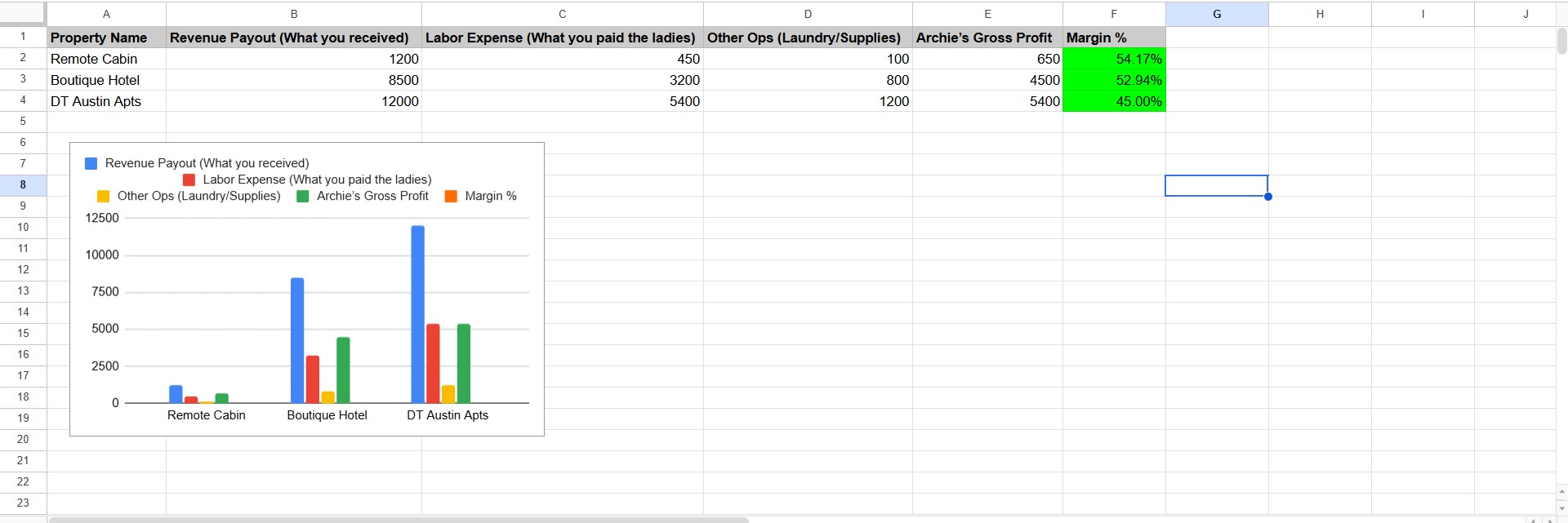
Geographic Margin Modeling: Engineering a 30% Yield Across Diverse Asset Classes
737-202-5325