
The Operational Autopsy: Identifying Systemic Failure
The Situation: A 45% Labor Leak
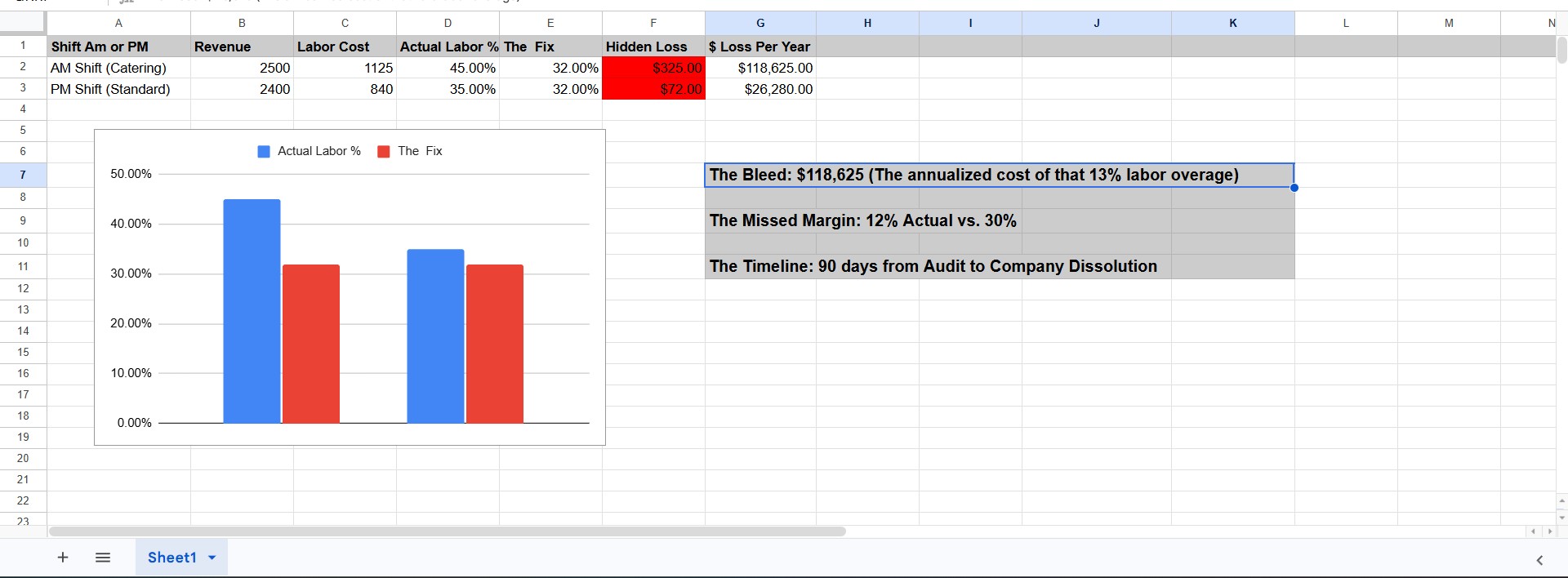
I was brought in to audit a company that was struggling to maintain profitability despite high top-line revenue. After a deep dive into the P&L and shift-level data, the core issue was identified: Labor was sitting at 45%. In a high-volume hospitality environment, that is a terminal number.
The Discovery: Leadership vs. Data
The Audit: The data showed that the company was over-staffing "dead zones" and failed to flex labor during non-peak hours. There was no accountability for productivity, and the scheduling was based on personal preference rather than sales volume.
The Solution: I presented a "Lean-Ops" model to bring labor back to the 30% industry standard. This involved a complete restructuring of the shift tiers and the implementation of performance-based KPIs.
The Conflict: When the data was presented to the COO, there was a fundamental refusal to implement the necessary changes. The leadership chose to maintain "comfortable" habits over operational sustainability.
The Decision: Professional Integrity
An operator is only as good as their ability to execute. When it became clear that the leadership was committed to a failing model despite the evidence, I made the decision to exit the project.
The Outcome: Market Validation
My exit was based on the mathematical certainty that the business could not sustain a 45% labor cost. The data was ignored, and the results were immediate:
T-Minus 60 Days: The specific location audited was unable to meet its obligations and was forced to shut down.
T-Minus 90 Days: The parent company, unable to pivot its operational model, dissolved entirely.
Forecasting Failure: A Post-Mortem of the 45% Labor Leak
737-202-5325